
₹503 crore EV charging push approved across India; Karnataka gets 1,243 chargers under PM E-DRIVE: H.D. Kumaraswamy
ADVERTISEMENT
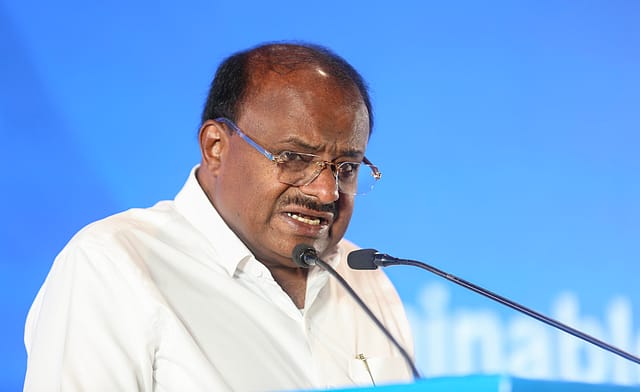
Union Heavy Industries Minister H.D. Kumaraswamy on Tuesday announced approval of EV charging infrastructure proposals worth ₹503.86 crore across states and central public sector undertakings (CPSUs), including a ₹123.26 crore allocation for Karnataka, as the Centre intensified efforts to accelerate India’s transition towards electric mobility.
Addressing the Conference on Enabling Nationwide EV Charging Infrastructure under the PM E-DRIVE Scheme in Bengaluru, Kumaraswamy said the approved proposals would support installation of 4,874 EV chargers nationwide, including 1,243 chargers in Karnataka alone.
“I am happy to announce approval of proposals for Karnataka involving 1,243 EV chargers with an outlay of ₹123.26 crore. So far, EV charging proposals with a total financial outlay of ₹503.86 crore have been approved, covering installation of 4,874 EV chargers across various states and CPSUs,” Kumaraswamy said.
The Minister added that ₹20 crore has already been released in the first phase and assured states of continued financial and policy support for expanding EV charging infrastructure.
It may be recalled that the Ministry of Heavy Industries (MHI) has extended demand incentives for Electric Two-Wheelers (E2Ws) under the PM Electric Drive Revolution in Innovative Vehicle Enhancement (PM E-DRIVE) scheme by four months, pushing the eligibility deadline to July 31, 2026.
₹2,000-crore charging infra push gathers pace under PM E-DRIVE
“In the second phase, whatever development proposals your state has shown today regarding EV vehicles and charging stations, I assure you from my department that we will support you fully and with confidence,” he said.
The approvals cover proposals from oil marketing companies including HPCL, IOCL and BPCL, along with states such as Rajasthan, Andhra Pradesh, Uttar Pradesh, Gujarat, Kerala, Telangana, Karnataka and Tamil Nadu.
Kumaraswamy said the government was pursuing a multi-pronged strategy to strengthen India’s clean mobility ecosystem and reduce import dependence in critical technologies. He highlighted that the Ministry of Heavy Industries has rolled out several large-scale incentive programmes to position India as a global manufacturing hub for future mobility technologies.
These include the ₹18,100 crore Production Linked Incentive (PLI) scheme for Advanced Chemistry Cell battery storage, the ₹25,938 crore PLI Auto scheme for cleaner vehicle technologies including EVs and hydrogen-powered vehicles, and the recently launched ₹7,280 crore Rare Earth Permanent Magnet (REPM) scheme aimed at boosting domestic manufacturing capabilities.
Karnataka emerges among top EV charging hubs as Centre clears 4,874 chargers nationwide
Calling the automobile industry central to India’s economic transformation, Kumaraswamy noted that the sector contributes over 7 per cent to India’s GDP, accounts for nearly half of manufacturing GDP and supports around 30 million livelihoods.
The Minister described the PM E-DRIVE scheme — with a total outlay of nearly ₹10,900 crore — as the cornerstone of India’s electric mobility transition. Of this, ₹2,000 crore has been earmarked specifically for deployment of public EV charging infrastructure across the country.
Highlighting Bengaluru’s emergence as one of India’s leading EV charging hubs, Kumaraswamy urged other states to accelerate implementation of charging networks across urban and rural regions alike.
Govt bets on batteries, rare earth magnets and unified charging app to deepen EV ecosystem
He also revealed that the Ministry is developing a National Unified EV Charging App — Unified Bharat e-Charge (UBC) — that would allow users to discover, access and pay across charging networks through a single platform.
“Just as UPI revolutionised digital payments, UBC is set to revolutionise EV charging in India,” Kumaraswamy said.
The Minister said the Centre, along with the Ministry of Power, state governments and industry stakeholders, is working to ensure grid readiness, standardisation and digital integration keep pace with rising EV adoption.
Calling the EV transition a defining moment for the country’s energy future, Kumaraswamy said, “Together, we are not merely installing charging stations, we are powering the future of India.”