
Commuter bikes to premium machines; what FY26 reveals about India’s reinvented two-wheeler industry
ADVERTISEMENT
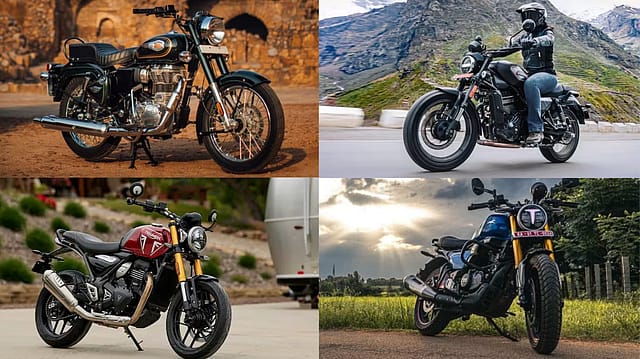
India’s two-wheeler industry closed FY26 on a relatively stable note, but earnings across leading manufacturers pointed to a deeper shift underway. Financial performance of companies such as Hero MotoCorp, TVS Motor Company , Bajaj Auto , Eicher Motors , and Ola Electric showed profitability is increasingly being driven by premium motorcycles, exports and product mix rather than pure commuter-bike volumes.
Hero MotoCorp, the country’s largest two-wheeler maker by volumes, reported revenue of around ₹47,500 crore in FY26 while net profit rose to nearly ₹5,800 crore. Even as the commuter motorcycle segment remained under pressure, management commentary increasingly focused on premiumisation and higher-margin products such as the Harley-Davidson X440, Xpulse, and Karizma.
TVS Motor Company emerged as one of the strongest performers during FY26, with revenue crossing ₹47,000 crore and operating profit before tax rising to nearly ₹5,000 crore, supported by premium motorcycles, scooters and export recovery. The Apache portfolio, electric scooters and overseas business supported margins and realisations.
Bajaj Auto also benefited from export recovery and rising contribution from premium motorcycles. The company reported revenue exceeding ₹52,000 crore during FY26, aided by overseas demand and premium products under the Pulsar, KTM and Triumph portfolio. Exports continued to provide a key earnings cushion for the company.
Eicher Motors perhaps offered the clearest example of the industry’s premiumisation shift. Royal Enfield crossed annual sales of 12.27 lakh motorcycles in FY26, with domestic sales rising 23% and exports growing 30%. Eicher Motors reported a 24% rise in consolidated revenue to ₹23,408 crore, while profit after tax increased 17% to ₹5,515 crore.
Ola Electric, meanwhile, highlighted the profitability challenges within the EV transition amid continued discounting and investments into technology and manufacturing ecosystems.

According to Crisil Ratings, margin expansion during FY26 was supported by a shift towards higher-cc motorcycles, operating leverage from industry volume growth and relatively stable commodity prices.
“Within motorcycles, which accounted for roughly 60% of industry wholesale volumes, the share of up to 150cc engines fell from 81.5% in FY25 to 76.9% in FY26, reflecting consumer preference for higher-cc models,” says Poonam Upadhyay, Director, Crisil Ratings. She added that scooter volumes grew 18.5% during FY26, with their share in industry volumes rising to 37.4%, aided by urban commuting trends and rising participation from gig economy users.
Industry executives and analysts increasingly point to a shift in India’s two-wheeler market. “Higher-end motorcycles and scooters are contributing disproportionately to earnings growth, with better pricing power and aspirational demand helping companies improve margins even as the commuter segment remains vulnerable to financing constraints and uneven rural recovery,” says Puneet Gupta, Director, S&P Global Mobility.
ICRA also noted that profitability across the sector increasingly reflected a richer product mix and export contribution rather than pure volume growth.
“OEM profitability was increasingly driven by an improved product mix, including premium motorcycles and scooters, as well as exports, which command higher realisations and support operating leverage,” says Rohan Kanwar Gupta, Vice President & Sector Head, Corporate Ratings, ICRA Limited. He added that the commuter motorcycle segment continues to face pricing pressure because of intense competition and high price sensitivity among entry-level buyers.
₹10,000-crore-plus investment cycle gathers momentum
Two-wheeler makers, including Honda Motorcycles and Scooters India (HMSI) are accelerating investments into EV platforms, manufacturing capacity and premium products, with leading manufacturers collectively lining up more than ₹10,000 crore (including HMSI) in investments for FY27.
Eicher Motors Limited has earmarked around ₹2,200 crore in capex for Royal Enfield during FY27, including nearly ₹1,000 crore towards capacity expansion and new product development. TVS Motor Company has outlined capex of around ₹3,500 crore towards EV expansion and premium motorcycle platforms, while Hero MotoCorp is expected to invest over ₹1,500 crore across electric mobility, digital technologies and premium products. Bajaj Auto is also estimated to invest around ₹1,000-1,500 crore towards EV development, premium motorcycles and global partnerships.