
How electrification helped BMW race past Mercedes to become India’s largest luxury carmaker
ADVERTISEMENT
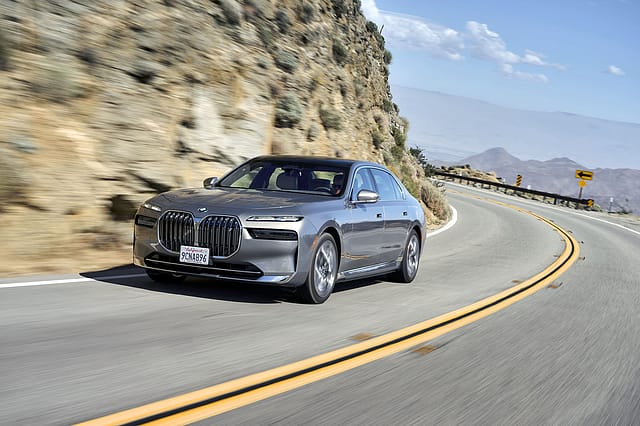
For the first time in over a decade, India has a new leader at the top of the luxury car segment.
Even if it's for a quarter, BMW Group has finally overtaken Mercedes-Benz, according to data from the government-run Vahan registration database. BMW India recorded 4,944 units in the January–March period of the calendar year 2026, compared with a combined 4,863 units for Mercedes-Benz India. That’s a difference of 81 units.
Three years ago, that difference stood at 1,734 units in Mercedes’ favour, which is also why the turnaround is rather striking.
Last year, BMW closed the gap to Mercedes by about 1,000 units, its closest numbers in a decade. “There are multiple factors,” Hardeep Singh Brar, the CEO of BMW India Group, told Fortune in an interaction earlier. “We launched multiple products last year. One of the biggest ones was the electric version of X1, iX1, which has really helped us attract a lot of consumers from the near premium into the luxury space. That really helped us in growing the segment. We also made changes to the X3, X5, and X7 as well.”
Then, apart from the product offensive, BMW also went on a network expansion spree, growing its presence to 40 cities, with more than 55 sales showrooms and 60+ service centers. “We brought in the assured buyback product for the electric vehicles we launched last year, so people don't have that apprehension,” Brar added. “So, a combination of the product, the network, and the financial services has really worked in our favor.”
But it is certainly BMW’s decision to go on the offensive with electrification that has turned the tide for the automaker. In early 2025, BMW launched a long-wheelbase version of the iX1. The electric equivalent of the company’s popular SUV was launched at around Rs 50 lakh. Now, this vehicle contributes over 85% of BMW’s electric vehicle sales in the country. BMW is India’s largest luxury EV maker, with sales of nearly 3,800 units a year. BMW Group India comprises BMW (including Motorrad, the German automaker’s motorcycles division), and British automobile brand Mini.
“We are getting the car (iX1) from China, and we are assembling it here,” Brar says. “So, the Chinese economy of scale is re[1]ally, really helping us to get the price points that we want.” Today, every fourth car BMW Group India sells is an EV, and it currently has over 70% market share in the luxury electric segment in India. The EV penetration of total sales stood at 26% in Q1. The company’s EV portfolio in the luxury segment comprises six electric cars and two electric scooters: BMW i7, BMW iX, BMW i5, BMW iX1 Long Wheelbase, MINI Countryman E, MINI Countryman SE ALL4, BMW CE 04, and BMW CE 02.
Fighting for the top
In comparison, Mercedes, the long-standing leader in the luxury market, has been increasingly turning its attention away from the entry-level segment to focus on its core and top-end segments, even while ramping up its electric vehicle lineup. That means products priced above ₹60 lakh, including the likes of the C-Class, E-Class, S-Class, and their SUV versions. The E-Class is Mercedes-Benz’s largest-selling vehicle and has been for many years.
But BMW’s strong showing has also meant that Mercedes will now bring an entry level electric car into its portfolio, expected to be priced between Rs 50 lakh and Rs 60 lakh. The CLA Electric is expected to be launched in late April.
“The iX1 has been an important catalyst. It brought EVs into a more accessible luxury price band and helped BMW tap into a new customer cohort,” says Harshvardhan Sharma, group head, automotive tech & innovation group at financial services group Nomura. “But the comeback is more structural. BMW has aligned well with key demand trends in India: SUVs, long-wheelbase formats, younger buyers, and early EV adoption. At the same time, Mercedes has also been evolving its portfolio, especially at the top end and in EVs. So, it’s not a case of one gaining at the expense of the other, but rather both sharpening their respective strengths.”
Currently pegged at $1.5 billion, India’s luxury car market is expected to grow to $1.92 billion by 2031, notes market research firm Mordor Intelligence. Rising household wealth is a key factor driving demand for luxury goods. As of 2025, India had nearly 870,000 millionaire households (with a net worth of around Rs 8.7 crore), according to the Mercedes-Benz Hurun India Wealth Report 2025—almost double the number in 2021.
Now that competition at the top is firming up, BMW Group will also continue its product offensive this year, with 23 products, of which eight will be launched over the next two months. Mercedes, meanwhile, has planned 12 new-car launches for the year.
Certainly, the fight at the top just got more interesting.
(Read about BMW's strategy for India in the April 2026 issue of Fortune India magazine, out now)