
Tesla’s India reality check: Booking cancellations and discounts flag weak Model Y demand
ADVERTISEMENT
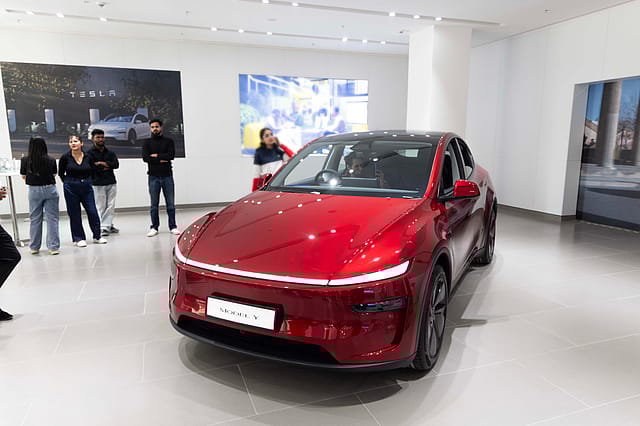
Tesla’s India operations are already facing early headwinds, with industry sources pointing to a wave of Model Y booking cancellations that has forced the Elon Musk-led electric vehiclemaker to recalibrate its approach. Cancellations are estimated in the range of 100–150 units, signalling a gap between initial interest and actual purchase intent in a price-sensitive market, according to people aware of the development.
To clear inventory, Tesla was also offering discounts of up to ₹2,00,000 ($2,200) on select variants, according to an earlier Bloomberg report—an unusual step for a company that has largely maintained global pricing discipline. The move highlights growing pressure to improve conversion in a market where buyers are increasingly benchmarking multiple premium EV options.
“There has been a visible drop-off from bookings to final purchases, with pricing emerging as a key friction point,” sources privy to the development told Fortune India, adding that many customers who initially booked the model have shifted to alternatives such as Mercedes-Benz CLA BEV or BMW iX1, due to shorter waiting periods and stronger feature bundles.
It may be recalled that Tesla had launched the Model Y at ₹59,89,000 (ex-showroom) in the Indian market, while the recently-launched Mercedes-Benz CLA Electric is priced at around ₹55 (ex-showroom) and the BMW iX1LWBis priced at about ₹66.90 lakh (ex-showroom).
An emailed query to Tesla’s global spokesperson remained unanswered till the time the story was published. However, India head Sharad Aggarwal has recently told reporters that the company is not overly concerned about near-term volumes, signalling a deliberate, long-horizon approach to scaling in the country.
Model Y L rolled out to withstand downturn
Against this backdrop, Tesla has introduced a six-seater version of the Model Y, which priced at ₹62 lakh (ex-showroom). The Model Y L sits between the standard Model Y (₹59,89,000) and the Model Y Long Range (₹67,89,000), and features a longer wheelbase with all-wheel-drive configuration. It claims a range of 681 km on a full charge, according to specifications listed on the company’s website.
Notably, the six-seater variant is yet to launch in Tesla’s home market, the US, though it was earlier introduced in China at a starting price of 339,000 yuan (about $49,687), based on company disclosures and market reports. Its India rollout signals a market-specific adaptation strategy, even as Tesla’s broader product pipeline remains limited locally.
The conversion challenge becomes clearer when viewed alongside booking momentum. Tesla had received around 1,200 bookings since opening orders in August 2025, but has managed to retail only 342 units until March-end, according to data shared by FADA. Since deliveries began, the US electric vehicle maker has been trailing rivals such as BYD, Mercedes-Benz and BMW by a wide margin, according to government registration data.
Premium pricing, structural gaps weigh on demand
Industry analysts reckon Tesla’s struggles in India are “structural” rather than “product-driven”. Exorbitant import duties, which are currently hovering near 100%, have pushed pricing firmly into the luxury bracket, sharply limiting addressable demand, according to industry trackers. The absence of a deep service network and limited charging infrastructure continues to weigh on ownership confidence.
Competition has also intensified, with established luxury carmakers and domestic EV players offering stronger value propositions at lower price points.
“Tesla’s weak sales in India are driven by structural issues, not product tweaks. High import duties push prices into the luxury bracket, but the brand lacks the service network and positioning to compete there. At the same time, infrastructure gaps and strong local EV players offering better value make it a poor fit for the market. Without local manufacturing and pricing in the ₹25–40 lakh range, traction will remain limited,” says Mohit Yadav, Director, Alt Info.
Adding a longer-term perspective, Avik Chattopadhyay, founder of brand consulting firm Expereal, said Tesla’s current approach may be more exploratory than aggressive.
“For Tesla, India seems a tick mark for now—‘Yes, we are in that market.’ But being one of the world’s most powerful brands, it would not want to be here just for that. This could be part of a long-term plan to test the market, understand customers better and develop more relevant products. While Tesla may not become large enough to unsettle mainstream players, it will look to carve out its own space over the next five to six years. So, I would not tick them off as yet,” he noted.