
Why Hero MotoCorp and Maruti Suzuki are betting on flex fuel while rivals double down on EVs
ADVERTISEMENT
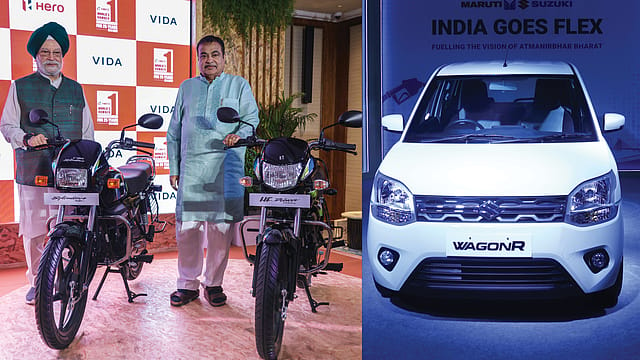
Hero MotoCorp and Maruti Suzuki unveiled flex-fuel vehicles within days of each other. The timing was striking because much of the Indian auto industry is moving aggressively in the opposite direction—towards electric vehicles (EVs).
From Tata Motors and Mahindra in passenger vehicles to TVS Motor and Bajaj Auto in two-wheelers, automakers have spent the past few years expanding their EV portfolios. Yet India's largest two-wheeler maker and biggest passenger vehicle manufacturer are simultaneously investing in technology designed to run on higher blends of ethanol.
The shift was visible last week when Hero MotoCorp unveiled flex-fuel versions of its Splendor and HF Deluxe motorcycles, while Maruti Suzuki showcased the WagonR Flex Fuel, signalling a parallel push towards ethanol-powered mobility.
The policy tailwind
The launches coincide with a broader policy push towards higher ethanol usage. Recently, the Bureau of Indian Standards (BIS) notified IS 19850:2026 for E22, E25, E27 and E30 fuels, creating a framework for higher ethanol compatibility in vehicles.
The push has extended beyond standards. On World Environment Day, Petroleum and Natural Gas Minister Hardeep Singh Puri launched E85 fuel at 48 retail outlets operated by state-run oil marketing companies. The government plans to expand the network to 500 outlets by December 2026 and around 5,000 outlets by the end of 2027 to support flex-fuel adoption.
Maruti Suzuki MD & CEO Hisashi Takeuchi recently argued that flex fuel aligns with India's twin goals of reducing oil imports and lowering emissions. "India has two national objectives: first, reduce dependence on imported crude oil; second, reduce carbon emissions. Flex-fuel meets both."
Hero MotoCorp CEO Harshavardhan Chitale has echoed that view. "Today, India imports nearly 85% of its crude oil, making us vulnerable to global price volatility and supply disruptions. It is important that we become 'Atmanirbhar' in energy."
A hedge or a practical solution?
The bigger debate is whether flex fuel represents a pragmatic response to Indian realities or a way for ICE-heavy incumbents to extend the life of existing technologies.
Puneet Gupta, Director, S&P Global Mobility, says the Indian market is unlikely to be defined by a single technology. "While EVs will continue to gain share, flex-fuel vehicles offer manufacturers an additional pathway to reduce emissions, particularly in mass-market segments where affordability and infrastructure constraints remain key considerations."
The economics are difficult to ignore. According to FADA data, two-wheeler retail sales crossed 2 crore units in 2025 and accounted for nearly three-fourths of all vehicles sold in the country. Industry observers note that flex-fuel vehicles can also be developed by adapting existing internal-combustion platforms, making the transition less disruptive than a full shift to EVs.
Shamsher Dewan, Senior Vice President and Group Head, Corporate Ratings, ICRA, says the strategy should not be seen as a departure from electrification. "India's mobility transition is likely to be gradual and technology-agnostic. Manufacturers are evaluating multiple pathways to meet sustainability objectives while addressing diverse consumer needs."
Bharati Balaji, Deputy Director General of the All India Distilleries Association (AIDA), believes the launches signal growing industry confidence in ethanol. "The decision by industry leaders like Maruti Suzuki and Hero MotoCorp to champion flex-fuel technology is a monumental validation of India's bio-energy vision."
Whether flex fuel ultimately emerges as a major mobility solution remains uncertain. But as rivals double down on EVs, Hero MotoCorp and Maruti Suzuki are betting that India's transition to cleaner mobility will be more gradual—and more technology-diverse—than many expect