
After groceries, instant home services eye quick commerce surge
ADVERTISEMENT
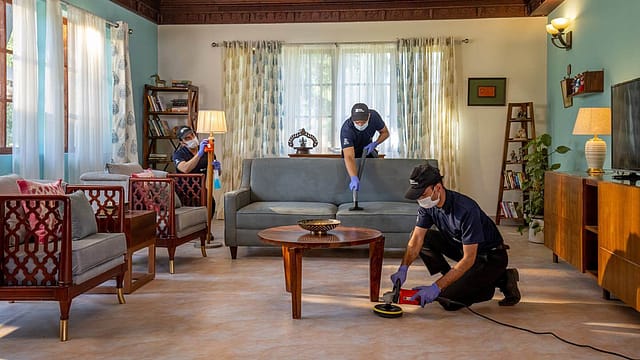
India’s domestic help ecosystem—long dominated by informal arrangements and neighbourhood referrals—is undergoing a structural shift. A new category of instant, app-based home services is emerging across metros, promising trained professionals at the doorstep within minutes for everyday chores such as cleaning, dishwashing and laundry.
Startups such as Pronto, Snabbit, and the instant vertical of Urban Company are racing to build scale in this segment, betting that urban households will increasingly outsource routine chores through digital platforms—much like groceries and transport before it.
The sector is still nascent but expanding rapidly, driven by changing consumer behaviour, dual-income households, and the need for reliable, on-demand support for everyday domestic work.
Is a fragmented market ripe for organisation?
India’s broader home services market is estimated at roughly $50 billion in annual spends, but less than 2% of this is currently transacted online, according to Snabbit’s internal estimates. The sheer scale of the largely informal workforce—and the inefficiencies faced by both households and workers—has created an opportunity for technology-led platforms to organise the sector.
“The market is massive and we will see a lot of exponential growth in the coming years,” says Anjali Sardana, founder and chief executive of Pronto. “Our goal is to become the primary house help solution for customers rather than just an emergency backup.”
Rather than viewing the opportunity narrowly as “instant house help,” Sardana defines Pronto’s addressable market as the total spend on household help across India.
A key signal of demand is usage frequency. Pronto’s top 1% of users currently book services more than 23 times a month, while the top 10% use the platform over nine times monthly—indicating that the service is gradually becoming a routine utility rather than an occasional convenience.
Is demand surging across metros?
The category is scaling quickly in urban India.
Pronto currently records around 18,000 daily bookings across 10 cities, with its strongest markets being Delhi NCR, Bengaluru, Mumbai, Pune and Hyderabad. NCR alone accounts for roughly half of its demand, while Bengaluru and Mumbai contribute about 20% each. Mumbai contributes around 12–15%, while Pune is emerging as a fast-growing market and Hyderabad remains smaller.
Meanwhile, rival platform Snabbit fulfilled 8.3 lakh orders in February, and claims roughly 40% share of the organised instant home services segment by booking volume.
Urban Company has also entered the race through its quick housekeeping vertical InstaHelp, which crossed 50,000 daily bookings within a year of launch after expanding beyond its initial pilot in Mumbai to select micro-markets in Bengaluru, Delhi NCR, Hyderabad and Pune. Urban Company declined to comment.
Together, these numbers suggest that the instant home services segment—though still small compared with the broader domestic help economy—is scaling rapidly in major cities.
What is driving the behavioural shift among urban households?
Industry players say the biggest driver of growth has been a behavioural shift among urban consumers.
“Urban households, especially dual-income families and young professionals, are increasingly looking for reliable, flexible solutions for everyday chores,” says Vikas Choudhary, CXO–Operations at Snabbit.
Speed reduces the need for advance planning. But the real unlock, Choudhary says, is reliability at the neighbourhood level—when customers know that a trained professional can reach them consistently within minutes.
As supply density improves within micro-markets, platforms are seeing faster adoption cycles. In some newer neighbourhoods, demand is ramping up far quicker than it did in early markets.
Repeat usage is critical to making the model viable. Services such as dishwashing, cleaning and home upkeep are recurring needs, and platforms are aiming to embed themselves into daily routines.
“The goal is to become a utility that households rely on regularly, much like ordering groceries or booking a cab,” says Choudhary.
What are the supply challenges?
Despite strong demand, the biggest constraint for the sector remains the availability of trained workers.
Sardana describes Pronto’s business as “supply constrained,” with demand growing roughly 20% week-on-week in some clusters.
To address this, the company recently raised $25 million in a Series B funding round led by Epiq Capital, with participation from existing investors including Glade Brook Capital, General Catalyst and Bain Capital Ventures. The round values the company at $100 million post-money.
Much of the capital will be directed toward supply acquisition and workforce development, including referral bonuses and technology systems that streamline recruitment and onboarding.
Platforms are also experimenting with different workforce models to improve retention and service quality.
How are operating models evolving?
Many home services platforms historically followed an aggregator model, where independent workers log in and accept jobs. But instant fulfilment has introduced new operational complexities.
Pronto uses a shift-based system that provides workers with predictable schedules and earnings. According to Sardana, this has helped achieve over 70% three-month retention among service professionals.
Snabbit, on the other hand, describes its model as “captive supply with flexibility,” where trained experts are attached to specific micro-markets while still retaining flexibility in working hours.
The aim in both cases is to ensure reliable availability and consistent service quality—critical when workers are entering customers’ homes rather than delivering goods.
“This business is very different from delivery platforms,” says Sardana. “Service professionals spend 30 minutes to an hour or more inside a customer’s home. The company that consistently delivers the highest quality service will win.”
Can the model expand beyond metros?
For now, most instant home service platforms are focused on metro markets, where consumer trust in app-based services is already established.
However, expansion into tier-II cities is firmly on the roadmap.
Pronto believes its variable-cost model—which avoids heavy infrastructure such as dark stores used in quick commerce—makes smaller markets more feasible to enter.
Still, building trust will be the biggest hurdle.
“Urban Company has already built trust for app-based home services in metro cities,” says Sardana. “In tier-II markets, we will need to work harder to build that trust.”
Will consolidation follow?
As venture funding flows into the category, some observers expect the sector to follow a trajectory similar to quick commerce—characterised by rapid scaling followed by consolidation.
Sardana believes consolidation is possible but says the long-term winners will be determined by execution rather than capital alone.
“Customers ultimately care about three things—quality, safety and reliability,” she says.
Industry players echo that sentiment. In a hyperlocal category where success depends on neighbourhood-level density, companies that build deep operational capability and strong customer trust are likely to emerge ahead.
What lies ahead for the sector?
For now, the opportunity remains largely untapped.
With less than 2% of India’s home services spending currently organised online, the category could see significant formalisation over the next decade.
If platforms succeed in making instant home help a daily habit for urban households, the segment could evolve into one of the most frequently used consumer services in Indian cities.
In other words, the next big shift in India’s digital economy may not be about delivering goods faster—but about bringing reliable domestic help to the doorstep on demand.