
Beyond the Box Office: Cinepolis bets on food, fintech, and premium experiences to drive growth
ADVERTISEMENT
India’s multiplex industry is undergoing a structural reset. Ticket sales may still anchor the exhibition business, but cinema operators are increasingly looking beyond the box office to drive growth through food, fintech partnerships, customer data, and branded experiences.
Cinepolis India, which operates 491 screens across 41 cities and serves around 40 million guests annually, is positioning itself as a broader consumer platform rather than just a movie exhibitor. From premium food offerings to banking tie-ups and AI-led personalisation, the company is building new revenue engines at a time when global uncertainty, including the ongoing West Asia crisis, continues to weigh on consumer sentiment and discretionary spending.
The strategy comes even as Cinepolis India’s financial performance reflects the volatility of the exhibition business. According to financial data sourced from Tracxn based on company filings, Cinepolis India reported revenue of ₹1,284 crore in FY25, compared with ₹1,388 crore in FY24, while EBITDA stood at ₹359 crore. The company posted a net loss of ₹61.3 crore in FY25 after reporting a profit of ₹32.1 crore in FY24.
“Ticket sales will continue to remain important, but the industry needs to move beyond just tickets,” Ashish Misra, head of commercialisation at Cinepolis India, tells Fortune India. “Customers today are committing a three-to-five-hour window with the exhibitor, and we need to deliver the best experience through that entire journey.”
The broader exhibition industry continues to grapple with profitability pressures despite a recovery in revenues and footfalls. PVR INOX, India’s largest multiplex chain, reported a consolidated net loss of ₹279.6 crore in FY25, compared with a narrower loss of ₹32 crore in FY24, reflecting the impact of high fixed costs and inconsistent content performance.
Can food and fintech partnerships reshape multiplex economics?
That strategy is becoming increasingly important as the cinema industry navigates volatile footfalls and changing audience behaviour. Cinepolis India MD Devang Sampat recently pointed out that while India’s box office collections crossed record highs in 2025, overall footfalls were still nearly 20% lower than 2019 levels, reflecting a more selective and experience-driven consumer base.
Misra says Cinepolis India has not witnessed any direct impact from the ongoing West Asia crisis on its business so far, though the company continues to monitor the situation closely.
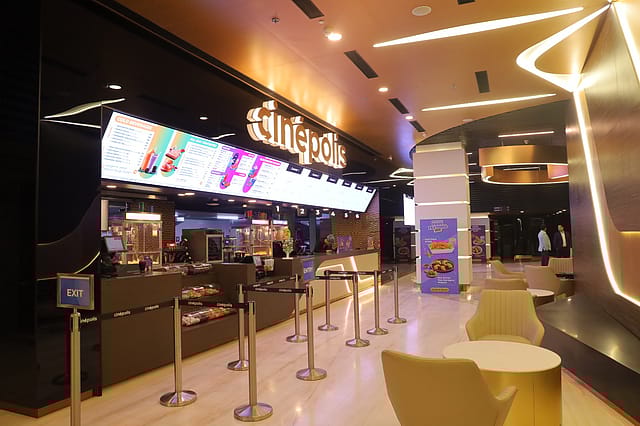
One of Cinepolis India’s biggest growth bets is food and beverage (F&B), which currently contributes around 30% of the company’s overall business. The company expects that share to rise further as it expands its FOOVIES platform and scales partnerships with FMCG and QSR brands.
“For us, F&B is no longer a counter business. It is a curated platform business,” says Misra.
The company has been experimenting aggressively with menu innovation, regional flavour customisation, and limited-period offerings such as the Blockbuster Food Festival. Partnerships with brands including Doritos, Crax, Costa Coffee, and Wow! Momo are aimed at transforming cinema food from a standard popcorn-and-soda experience into a differentiated consumption category.
The strategy also reflects a wider industry trend towards premiumisation. As cinema-going becomes more planned and less impulse-driven, multiplex operators are increasingly relying on higher spends per consumer rather than pure admission growth. Premium formats such as IMAX, 4DX, recliner seating, and elevated food offerings are becoming critical drivers of profitability.
Misra says Cinepolis expects a 15-20% increase in F&B-led growth this year, driven by these interventions. Financially, the business continues to see strong operating leverage despite elevated fixed costs such as rentals and depreciation. Cinepolis’ EBITDA margin stood at nearly 28% in FY25, even as finance costs remained high at ₹196.8 crore.
A major part of the strategy revolves around increasing “spend per head” — a key metric that measures how much customers spend on food relative to ticket purchases. According to Misra, Cinepolis’ global markets often see food spending exceed ticket spending, while India currently remains at roughly half that level, leaving significant headroom for growth.
“Customers are increasingly looking for a complete leisure experience, and food is a critical part of that,” he says.
Why are banks and brands chasing cinema audiences?
Technology is also playing a growing role in the company’s commercial strategy. Cinepolis is using AI-driven customer segmentation and behavioural analysis to personalise promotions and improve repeat engagement.
“If a customer regularly books recliner seats and orders cheese popcorn, we can create tailored offers around those preferences,” Misra explains. “AI helps us understand customer behaviour better and remove friction from the overall experience.”
That “friction reduction” strategy extends to the ticket-buying process as well. Cinepolis has built a growing network of partnerships with banks, fintech firms, and payment platforms including AU Bank, SBI Cards, Yes Bank, Paytm, CRED, Amazon Pay, and MobiKwik. Another fintech partnership is expected to go live soon.
The company says these collaborations are less about discounting and more about customer acquisition and accessibility.
“We don’t treat ticket purchases as transactions. For us, it’s a journey,” says Misra. “The idea is to make cinema-going more accessible and more rewarding for customers.”
The commercial structures behind these deals vary across categories. Banking partners typically underwrite discounts or cashback offers to drive card usage and transaction volumes, while FMCG partnerships operate through co-branded campaigns, placement agreements, and exclusivity-led models.
For brands, cinemas are emerging as valuable engagement environments at a time when digital advertising is becoming increasingly fragmented.
“Cinema remains one of the few environments where customer attention is fully captive,” Misra says. “People are in a leisure mindset, highly engaged, and more open to discovery.”
As multiplex chains navigate an increasingly competitive entertainment landscape, Cinepolis’ strategy reflects how cinema operators are evolving into broader experiential commerce businesses — where food, payments, loyalty, and data may become just as important as the film itself.