
How Marriott is using cricket to drive loyalty enrolments and travel demand
ADVERTISEMENT
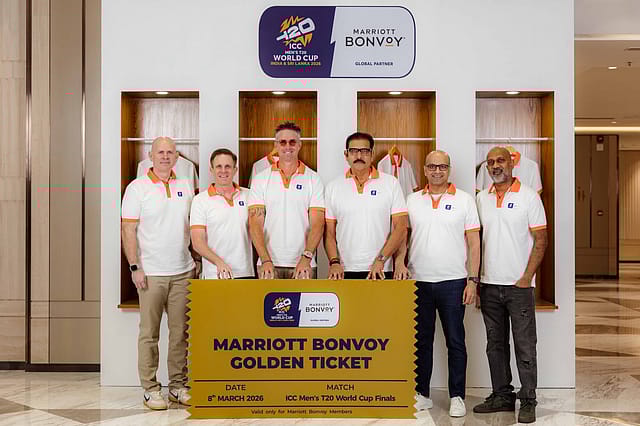
As India’s experience economy around sport gathers momentum and cricket entrenches itself as the country’s most powerful consumer platform, Marriott Bonvoy is positioning the game as a strategic lever to deepen loyalty, boost engagement, and drive travel demand. The company has rolled out over 500 curated “Marriott Bonvoy Moments” linked to the ICC Men’s T20 World Cup 2026, placing immersive experiences—rather than price-led promotions—at the core of its marketing and loyalty play.
The initiative, which begins rolling out from February, is part of Marriott International’s global partnership with the International Cricket Council (ICC) and gives members access to bespoke experiences across India and Sri Lanka, the tournament’s host markets. The push comes amid a broader shift in consumer behaviour, with Indian travellers increasingly prioritising personalised, passion-led travel over material consumption—and expecting loyalty programmes to deliver access and exclusivity.
From visibility to measurable business outcomes
Marriott executives said the ICC partnership is structured around tangible commercial metrics: new member enrolments, deeper engagement with points, incremental bookings linked to marquee matches, and long-term brand relevance.
“Marriott leaning into cricket is about striking passion points that are deeply embedded in India,” said John Toomey, Chief Commercial Officer, Asia Pacific (excluding China), Marriott International. “Cricket is a religion here, and partnering with the ICC allows us to bring the sport to our members in a thoughtful and meaningful way—whether that’s using points to attend a match or accessing experiences like walking on the pitch or meeting cricket legends.”
Toomey said the objective extends well beyond traditional sponsorship visibility. “It’s more than logos on backdrops or billboards. It’s about enrolments, activation and building awareness in a way that’s genuinely relevant for our current members—and future members,” he said.
Effectiveness, executives said, is measured across the entire customer funnel—awareness, enrolment, redemption of points for experiences and eventual hotel stays in India and overseas.
Loyalty beyond ‘earn and burn’
The 500-plus curated experiences span premium matchday hospitality, “Beyond the Boundary” pre-match pitch access, and family-focused offerings such as the Marriott Bonvoy Anthem Kids Experience, which allows children to walk onto the field with players during the national anthem.
These Moments are available globally to members via the Marriott Bonvoy platform, with new experiences being released progressively. The flagship offering is the Marriott Bonvoy Golden Ticket—an all-access finals experience that includes premium hospitality, accommodation within the Marriott Bonvoy hotel portfolio and behind-the-scenes access. Two Golden Tickets are available: one through a global sweepstake and another via points bidding.
At the other end of the spectrum are “1-point drops”, where members can redeem a single Marriott Bonvoy point for a pair of general admission tickets to high-demand fixtures such as the India–Pakistan match in Colombo. Ten such 1-point drops will be released on February 2, 2026.
“The truth is, members want their loyalty programme to be more than just an earn-and-burn model,” Toomey said. “They want moments and memories that last a lifetime.”
Tapping India’s experience-led travel boom
The strategy aligns closely with wider travel trends in India. Marriott executives point to a growing willingness to spend on experiences, a rise in multigenerational travel, and increasing outbound travel from Tier II and Tier III cities as air connectivity improves.
“What we’re seeing in India—and globally—is that consumers are willing to forego small daily indulgences or even material purchases so they can travel and have meaningful experiences,” Toomey said.
Andrew Watson, Chief Commercial Officer, Europe, Middle East & Africa, Marriott International, said sport-led partnerships are critical to capturing those high-intent moments. “The number of eyeballs on sport is enormous, and it gives us a powerful way to connect with new audiences,” he said. “That new-audience piece is absolutely vital.”
Watson said the ICC partnership also enables seamless cross-border travel for members. “Cricket’s heartbeat is truly global. This partnership gives our members across EMEA a simple way to travel to India and Sri Lanka—combining curated itineraries with on-the-ground hospitality and experiences,” he added.
Cricket-linked travel is already translating into movement across borders, with Marriott seeing heightened interest in travel to Sri Lanka around marquee matches.
Standing out in a cluttered sponsorship market
India’s cricket season is among the most crowded brand environments globally. Marriott’s differentiation strategy hinges on exclusivity and participation—experiences that conventional sponsorships cannot replicate.
“These are moments money genuinely can’t buy,” Watson said. “From children walking out for every anthem during the tournament to behind-the-scenes access and premium hospitality, it’s the rareness that creates real engagement.”
Former India head coach Ravi Shastri underscored the role of hospitality in sports-led travel. “If you don’t have a good place to stay, the whole experience means nothing—whether you’re a spectator or a player,” he said.
Former England cricketer Kevin Pietersen echoed that sentiment, noting that fans increasingly value access over merchandise. “People love experiences today. Bringing fans closer to the game is a win for everyone,” he said.
Long-term play in a key growth market
With India emerging as a critical growth engine for Marriott globally—and aspirations rising rapidly beyond the metros—the ICC partnership is also a long-term bet.
“There was a time when India had fewer than 50 airports. In the next few years, it will be close to 200,” Toomey said. “When people in smaller cities see families walking onto the pitch with their children during a World Cup match, it creates aspiration.”
For Marriott, the strategy is clear: by embedding itself at the intersection of cricket, travel and once-in-a-lifetime experiences, it is seeking to convert India’s passion for the sport into sustained loyalty, repeat stays and long-term customer value—well beyond the final over.