
Ujjivan Small Finance Bank shares drop 6% as RBI rejects universal bank bid
ADVERTISEMENT
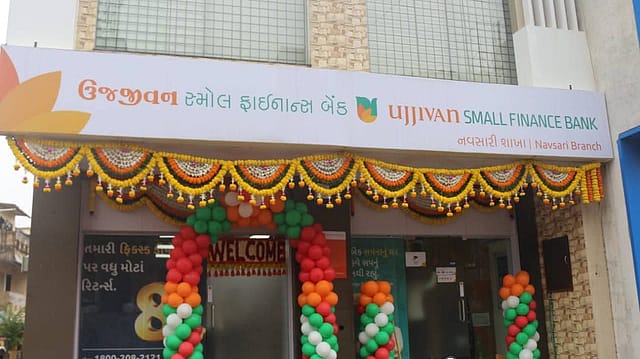
Shares of Ujjivan Small Finance Bank witnessed sharp selling pressure on Wednesday, despite a strong rally in the broader market, as sentiment was dented after the Reserve Bank of India declined its application for a universal banking licence (UBL).
Weighed down by the development, Ujjivan SFB shares declined as much as 5.94% to hit a low of ₹56.75 on the BSE, while its market capitalisation dropped to ₹11,093 crore. The shares of the small-sized lender had touched a 52-week high of ₹68 on January 23, 2026, and a 52-week low of ₹38.91 on April 16, 2025.
In calendar year 2026, Ujjivan Small Finance Bank shares have delivered a positive return of 6%, while gaining more than 13% in the past one month. The stock has surged 43% over the past year and risen 17.5% in the last six months.
Why did RBI reject the universal bank bid?
The Bengaluru-headquartered Ujjivan SFB had applied for a transition into a universal bank on February 4, 2025, and has now received formal communication from the regulator returning its application. The primary reason cited was insufficient diversification in its loan portfolio.
The company was incorporated in 2005 as Ujjivan Financial Services Limited (UFSL), a non-banking financial company founded by Samit Ghosh to provide microfinance to the “economically active poor.” After receiving a licence from the RBI, it commenced banking operations on February 1, 2017.
While the RBI acknowledged the bank’s recent efforts to rebalance its loan book, it emphasised the need for greater diversification before granting approval and advised the bank to reapply once it demonstrates a more balanced portfolio.
“The RBI took note of the bank’s recent efforts towards diversification of its loan portfolio. However, they were of the view that there is scope for further progress in this area. Therefore, RBI has returned the application and advised the bank to consider reapplying after achieving a more diversified loan portfolio,” Ujjivan SFB said in a BSE filing on April 13.
Notably, Ujjivan SFB had met all key quantitative eligibility criteria for a universal banking licence, including a minimum net worth of over ₹1,000 crore, GNPA/NNPA below 3%/1% for two consecutive years, a five-year operational track record, and listing on stock exchanges. However, the rejection indicates that regulatory approval hinges not only on meeting numerical thresholds but also on qualitative factors such as portfolio composition.
RBI decision surprises analysts
According to Equirus Capital, the outcome, while long awaited, comes as a surprise given the bank’s progress in reducing unsecured exposure. “While the outcome is somewhat surprising—given that all quantitative eligibility criteria were met—the decision is broadly driven by a subjective assessment of loan book diversification,” it said in a note.
The brokerage noted that Ujjivan SFB’s share of unsecured loans has declined from around 61% at the time of application to nearly 51% as of March 2026, reflecting a meaningful shift toward a more balanced portfolio. It added that the lack of clarity around what constitutes “adequate diversification” remains a key overhang.
Equirus maintained that it had not factored in any benefits from a potential universal banking licence in its FY27–FY28 estimates, given the longer gestation period required for such a transition.
The brokerage expects the stock to react negatively to the development in the near term. It has retained a ‘Long’ rating on the stock with a target price of ₹75 for March 2027, reflecting confidence in the bank’s underlying fundamentals despite the regulatory setback.
Axis Securities has also reiterated its ‘Buy’ recommendation on Ujjivan SFB with an unchanged target price of ₹74 per share, stating that while the development is sentimentally negative, it could weigh on the stock in the near term.
“We believe this is a good accumulation opportunity. Q4 should see strong performance, and we expect improved performance over the medium term, with improving credit costs and lower opex ratios adequately offsetting NIM compression (due to portfolio mix shift), driving RoA/RoE improvement to 1.7–1.9%/15–18% over FY27–28E,” it said.
(DISCLAIMER: The views and opinions expressed by investment experts on fortuneindia.com are either their own or of their organisations, but not necessarily that of fortuneindia.com and its editorial team. Readers are advised to consult certified experts before taking investment decisions.)