
Iran must allow shipments through Strait of Hormuz as part of peace agreement, says Donald Trump
ADVERTISEMENT
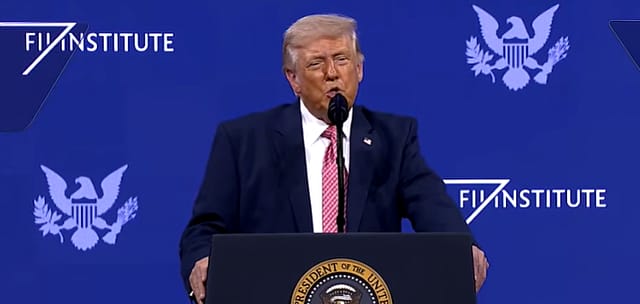
U.S. President Donald Trump on Friday said Iran must allow energy shipments through the Strait of Hormuz as part of any peace agreement, underlining the growing economic urgency around the conflict-hit region.
Speaking at a Saudi-backed FII Priority investment forum in Miami, Trump said Tehran’s cooperation on reopening the critical shipping lane would be central to ongoing negotiations.
“We're negotiating now, and it would be great if we could do something, but they have to open it up. They have to open up the Strait of Trump -- I mean Hormuz. Excuse me, I'm so sorry. Such a terrible mistake,” the President joked.
Trump later referred to the remark as a slip and added that “there's no accidents with me, not too many,” suggesting the comment would draw media attention.
Oil flows disrupted, prices surge
The remarks come as the closure of the Strait of Hormuz has emerged as the most pressing risk to the global economy. The route is the world’s busiest oil transit corridor, handling a significant share of global petroleum shipments.
The disruption has sharply curtailed supply, pushing fuel prices higher and forcing key oil-producing nations in West Asia to cut output by millions of barrels per day. Energy markets have remained volatile, with concerns over prolonged supply constraints weighing on global growth.
Strategic choke point
The Strait of Hormuz is a narrow, curved waterway about 33 kilometres wide at its narrowest point, linking the Persian Gulf to the Gulf of Oman and beyond to international markets.
It serves as the primary export route for crude and liquefied natural gas from major producers including Saudi Arabia, Iraq, Kuwait, Qatar, Bahrain, the United Arab Emirates and Iran. Control over the passage has long been a key strategic lever for Tehran.
Historically, the route has facilitated trade ranging from silk and textiles to modern energy supplies, making it one of the most critical maritime corridors globally.
Talks underway amid heightened tensions
Trump reiterated his claim that Iran is open to a deal despite public denials, noting that discussions to end the month-long conflict are ongoing. He said Iran was “on the run” and claimed that its leadership, navy, air force and nuclear programme had suffered heavy damage.
The waterway, which was open to global shipping before the conflict, remains blocked, continuing to strain energy markets and heighten geopolitical risks. Analysts say any breakthrough on reopening the route could ease supply pressures and stabilise prices in the near term.