
Maruti, Hyundai, Nissan, Renault, VW-Skoda may defer MENA shipments amid Hormuz risks
ADVERTISEMENT
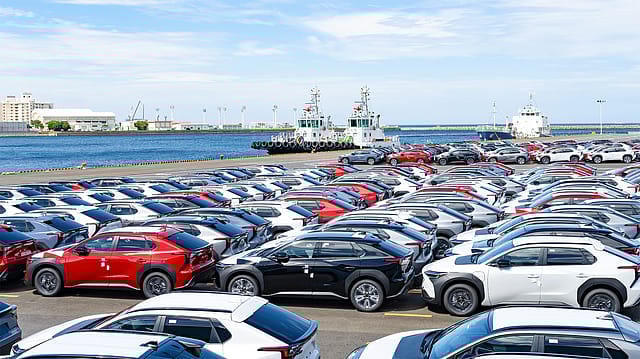
Escalating geopolitical tensions in West Asia are beginning to disrupt India’s automobile export supply chains, prompting several manufacturers to review vehicle shipments to the Middle East and North Africa (MENA).
Industry sources familiar with the developments told Fortune India that several major automakers operating in the country are reviewing shipment schedules for passenger and commercial vehicles bound for the region amid heightened geopolitical uncertainty.
Companies with export exposure to the Middle East include Maruti Suzuki India Ltd., Hyundai Motor India Ltd., Mahindra & Mahindra, Nissan Motor India, Renault India, Toyota Kirloskar Motor, Škoda Auto Volkswagen India and Kia India. Earlier, Bloomberg reported that automakers were reviewing shipments to the region as geopolitical tensions intensified.
The uncertainty follows intensifying hostilities involving Iran, Israel and the United States, which have heightened security concerns around the Strait of Hormuz. The waterway connects the Persian Gulf to the Arabian Sea and remains one of the world’s most critical maritime routes for global energy supplies and cargo movement.
Export growth engine faces short-term disruption
Exports have emerged as a key growth driver for India’s automobile industry in recent years. Industry data show that India exported around 7.7 lakh passenger vehicles in FY25, the highest on record. Overall automobile exports—including two-wheelers, commercial vehicles and three-wheelers—crossed 5.3 million units during the fiscal year, reflecting growing global demand for vehicles manufactured in the country.
Vehicles produced in India are now shipped to more than 100 international markets, with South Africa, Saudi Arabia, Mexico, Japan and the United Arab Emirates among the key destinations. The Middle East remains particularly important, accounting for roughly a quarter of India’s passenger vehicle exports by value in calendar year 2025.
For many automakers, export shipments can be postponed only for a limited period before operational constraints begin to emerge. Manufacturers can typically hold back overseas dispatches for two to three weeks before storage capacity and working-capital considerations begin to exert pressure on operations, according to a report by the aforementioned newswire agency. If disruptions persist beyond that window, companies could face pressure on export volumes as well as working capital cycles.
Carmakers monitor evolving geopolitical risks
For Maruti Suzuki India, the Middle East remains an important yet manageable export destination. The company exports vehicles to markets such as Saudi Arabia, the United Arab Emirates, Kuwait, Oman and Qatar.
“Shipments to the Middle East account for about 12.5% of our total exports, or roughly 50,000 units between April and February FY26,” said Rahul Bharti, Senior Executive Officer at the company. “We are closely monitoring the evolving situation in the region. While global events like these can raise concerns, our exposure remains relatively limited.”
Bharti added that the company continuously reviews shipment plans and market dynamics to manage geopolitical uncertainties. “We are not just increasing exports; we are expanding them in a strategic and diversified manner. Our teams are constantly assessing markets, adjusting shipments and balancing demand so that operations remain resilient even during periods of volatility.”
Exposure to Middle Eastern markets varies widely among automakers operating out of India. Industry estimates suggest nearly half of Hyundai Motor India’s export shipments are directed to Gulf markets, making it among the most exposed players. Japanese automakers also rely heavily on the region; a substantial share of Toyota Motor Corporation’s vehicle exports from India are shipped to Middle Eastern destinations. Meanwhile, exports from Nissan Motor India to the region account for over one-third of its overseas shipments by value.
Emailed queries sent to spokespersons of Mahindra & Mahindra, Tata Motors, Hyundai Motor India Ltd., Kia India, Toyota Kirloskar Motor and Renault India did not elicit a response.
Other passenger carmakers such as the Volkswagen Group said they are closely monitoring developments. “The Volkswagen Group is very concerned about the situation in the region and hopes that hostilities affecting civilian populations will soon end,” a company spokesperson said in an emailed statement. The automaker added that it currently sees no impact on production and that the safety of employees in the region remains a priority.
Similarly, Nissan Motor India said it is tracking the situation and evaluating potential implications. “We are closely monitoring the situation and assessing any potential impact on our operations. We are working with our teams and partners to maintain continuity in line with local conditions and official guidance,” the company said.
Rising freight costs, market jitters cloud outlook
Apart from shipment delays, rising logistics expenses remain a key concern for automakers. If shipping routes are altered or insurers raise risk premiums for vessels operating in the region, freight costs could increase significantly for exporters.
Typically, logistics expenses account for 1–3% of revenue in the automobile sector, but this share could rise if shipping lines reroute vessels or adjust schedules due to security concerns in the Gulf region.
Financial markets have already begun reflecting these concerns. The NSE Nifty Auto Index has declined about 5% since tensions escalated in West Asia, signalling investor apprehension that prolonged instability around the Strait of Hormuz could affect export volumes, logistics costs and profitability for automakers and component manufacturers.
Industry analysts say sustained disruption to shipping routes in the Gulf could delay vehicle deliveries and increase costs for exporters.
“Exports to the Middle East constitute around 25–30% of total passenger vehicle exports from India in value terms, with Saudi Arabia and the UAE emerging as key destinations,” said Rohan Kanwar Gupta, Vice President and Sector Head, Corporate Ratings at ICRA Limited.
According to him, Indian OEMs primarily export affordable hatchbacks, compact sedans and compact SUVs to the region, leveraging the country’s cost-competitive manufacturing base. “The ongoing conflict poses near-term risks through elevated freight and insurance costs as well as potential shipment delays due to stress on key maritime routes. A prolonged conflict could therefore constrain export volumes and earnings for automakers,” he added.
The Middle East nevertheless remains an important export market for India’s passenger vehicle manufacturers, accounting for a double-digit share of shipments, with Saudi Arabia and the United Arab Emirates together comprising the bulk of exports to the region, revealed Hemal Thakkar, Director at Crisil Intelligence.
"While the current tensions could create short-term disruptions through higher freight costs, insurance premiums and vessel availability, the longer-term impact on Indian passenger vehicle exports is likely to remain limited given the diversified export footprint of large manufacturers. Demand in the region may soften temporarily but is expected to recover once geopolitical conditions stabilise," he added.