
India’s digital economy may hit 20% of GDP by 2030: MeitY Secretary S Krishnan
ADVERTISEMENT
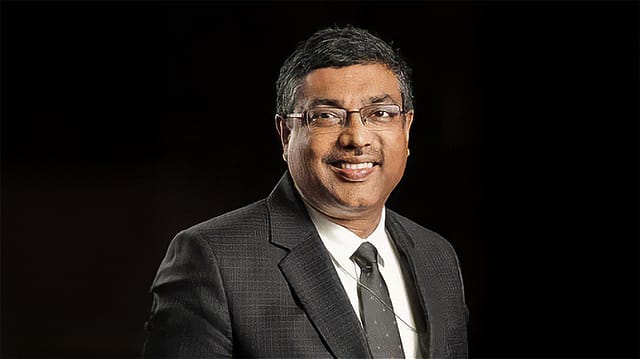
India’s digital economy could account for nearly a fifth of GDP by 2030, even as global technology and trade systems undergo deep structural shifts, S. Krishnan, secretary at the Ministry of Electronics and Information Technology (MeitY), said at Nasscom's Global Confluence.
“There is a major transition going on… and nothing really stands still in the technology industry,” Krishnan said, pointing to a phase where both global systems and digital technologies are evolving rapidly against the backdrop of the ongoing West Asia conflict. “We are in a period of fairly great uncertainty.”
Against this backdrop, he argued that policymaking and industry strategy must focus on identifying strengths while building safeguards against emerging vulnerabilities. “In a period of uncertainty, what is it that you do, and what is it that you can rely on? That is what discussions need to centre on,” he said.
One clear anchor, he noted, is the irreversible shift towards digitisation. “The fact that we are getting more digitised… and that this is going to dominate the way various economies transition is something we cannot ignore,” he said.
India’s digital economy - spanning IT services, IT-enabled services and electronics - currently contributes about 13% to GDP and is expanding at twice the pace of the broader economy. “It will end up being almost about 20% of India’s GDP by 2030,” Krishnan said, adding that the adoption of artificial intelligence could accelerate this trajectory further.
At the same time, he flagged a parallel shift in global trade dynamics, with increasing retrenchment from the hyper-globalised model that prioritised efficiency and geographic specialisation. “The world believed that we reached a stage of stability… where you produce at the most efficient locations and trade across jurisdictions,” he said. “Clearly, that is not the case now.”
However, Krishnan cautioned against interpreting this shift as a move towards complete self-reliance. “That doesn’t mean you turn completely inwards and try to make everything yourself, that is not realistic,” he said.
Instead, he emphasised resilience as the new organising principle. “Resilience comes from diversification and having alternatives,” he said, positioning India as a key player in this evolving framework.
He pointed to India’s recent global AI engagement as evidence of this positioning. “What the summit demonstrated was India bringing together leading minds and demonstrating how we can actually democratise AI,” he said.
According to Krishnan, India’s approach to AI focuses on broad-based access - spanning compute, models and data. “We have created a model which enables all three of these to be available on a more democratic basis, at a more affordable price,” he said, adding that AI compute is now accessible to Indian innovators at roughly a third of earlier costs.