
Why Air India might be keen on Vinod Kannan and Nipun Aggarwal
ADVERTISEMENT
It’s without doubt the most difficult job in the world of aviation.
And to pull it off, Air India now needs a seasoned taskmaster, something the board of the country’s second-largest airline will likely deliberate as a top priority when it meets on May 07 in Mumbai. In the running are two old hands, one who has spent a lifetime in aviation, having tided over multiple turbulences, in India and abroad, while the other has emerged as a tough taskmaster in the last few years, with total control of Air India Express, the low-cost airline of Air India.
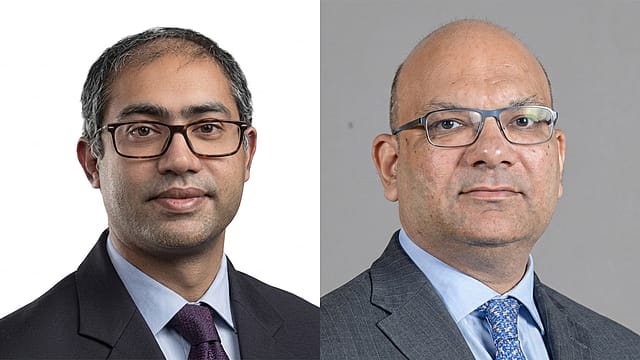
Vinod Kannan had once run India’s best full-service carrier, Vistara, before leaving for Singapore after the airline’s merger with Air India, even as Nipun Aggarwal tightened his grip on Air India, from inside, as the chairman of Air India Express over the past few years. Aggarwal is also the chief commercial and transformation officer of Air India, a role he took on four years ago.
“Air India Express is essentially Nipun’s baby now,” an aviation expert says on condition of anonymity. “He has full control over how the airline is run.” The need to find a new head to run Air India has arisen in the wake of Campbell Wilson’s resignation last month. Wilson, who once likened turning around Air India to playing test cricket—requiring enormous patience and a winning formula—has begun serving his notice period.
The airline has already set up a committee to find Wilson’s replacement, and the Air India board is currently evaluating the candidatures of Kannan and Aggarwal. There are reportedly two more global CEOs in the running for the top post of Air India, which has mopped up losses of some Rs 22,000 crore in the last fiscal, and is under severe strain due to the ongoing war in the Middle East, which has pushed up fuel costs and shut down airspace.
Air India’s decision, if any, to go with an Indian CEO, will be in contrast to that of India’s largest IndiGo, which has roped in Willie Walsh, the current director general of IATA, in place of Pieter Elbers, who had left the airline a few months ago after the cancellation fiasco in December last year. The two airlines are likely to corner most of India's air travel over the next decade, as the country’s aviation sector emerges as a duopoly, with both controlling as much as 92 percent of domestic travel.
Kannan and Aggarwal
Vinod Kannan is currently the senior vice president for sales and marketing at Singapore Airlines and has spent about 6 years at Vistara as its first Indian CEO. Singapore Airlines holds a 25.1% stake in Air India and has reportedly been actively involving themselves in Air India’s operations. At Vistara, Kannan had seen the airline through a period of turbulence with Covid-19 but managed to keep its market share intact. An aviation veteran, Kannan began his career at Singapore Airlines a few months after the 9/11 crisis sent the aviation sector into a tailspin.
Before he joined Singapore Airlines, the Bengaluru-born Kannan had just finished his master’s degree in high-performance computing from the Singapore-MIT Alliance, a global partnership in graduate education between MIT, the National University of Singapore (NUS), and Nanyang Technological University (NTU). He had joined Singapore Airlines in August 2001, a month before the September 11 attacks, which hurt the aviation sector hard.
Nipun Aggarwal, in contrast, has been serving as Air India’s Chief Commercial Officer & Transformation Officer since 2022. Aggarwal had joined the airline in 2022 after playing a critical role in the Tata Group’s acquisition of Air India in 2021. An engineering graduate from Delhi College of Engineering, Aggarwal has worked across infrastructure, energy, and banking, among others, before joining Tata Sons, the holding company of the salt-to-infrastructure major, Tata Group.
Aggarwal, who has served on the boards of various Tata Group companies, was instrumental in the acquisition of Air India by Tata Sons and in spearheading the team that secured record-setting aircraft and engine purchase deals for Air India. In June 2023, Air India signed an agreement to acquire 470 aircraft from Boeing and Airbus. Nipun’s growing influence has been evident at Air India Express, especially after Aloke Singh, the former managing director of Air India Express, left the airline to join IndiGo as its chief strategy officer.
Indian vs Foreign CEO
Now that Air India is considering a replacement, questions also arise about the need to look outside India for leaders capable of running an airline, given India's third-largest aviation market.
Traditionally, India has had a slew of foreign CEOs running its private airlines, dating back to Jet Airways. Between 2003 and 2009, Jet Airways, then India’s largest private airline, was run by Wolfgang Prock-Schauer. Prock-Schauer was followed by Nikos Kardassis, who led the airline between 2009 and 2013 and had led it earlier between 1994 and 1999. Vistara appointed Leslie Thng, of Singapore Airlines, as its CEO in 2017.
“After all these years, it's rather unfortunate that neither Jet Airways nor Air India could throw up any leaders who could shape Indian aviation,” Jitender Bhargava, a former executive director of Air India and author of The Descent of Air India, had told Fortune India earlier. “Whether it was engineering or commercial, they all worked in silos. We must also remember that aviation is a global industry. But not having built our own leaders is something to think about.”
India is the world’s third-largest aviation market, and its airports have grown from 74 in 2014 to 163 in 2025. The government wants to raise that to 350-400 by 2047. By 2040, passenger traffic is expected to grow sixfold to around 1.1 billion. India’s commercial airline fleet is predicted to grow from 400 in 2014 to around 2,359 in March 2040. The total employment due to the aviation sector in 2040 is expected to be around 25 million.
For much of its 158-year-old history, the Tata group has seen expatriate CEOs come and go in many of its verticals. Among others, Darryl Green led Tata Tele Services while Raymond Bickson and Guenter Butschek helmed Indian Hotels and Tata Motors, respectively. “
Mr.Wilson came in with a credible plan and had moved the airline in the right direction, but he’s been constrained by aircraft delays, integration complexity, legacy operational inertia, and an overall perception of poor quality,” Alok Anand, the chairman of Acumen Aviation, an aircraft asset management and leasing company, told Fortune India earlier. “While the intentions were correct and a blueprint was drawn, the execution unfortunately lacked a lot. Boards only care about outcomes and results, so perhaps that’s where the issue is. On a scale of 1 to 10, I would say 6.5 can be considered a fair rating.”
In March this year, the Air India Group’s domestic market share stood at 26.2 percent, with IndiGo’s well over 63 percent. In January 2023, a full year after the Tata Group acquired Air India, Air India's market share stood at 25.4. percent while IndiGo’s was at 54.6 percent.
The constant delays in Air India’s turnaround have also been due to external factors, not entirely to Air India’s own shortcomings. That’s also something the new CEO will likely have to keep in mind. McKinsey reckons that only about 7,000 aircraft were delivered in the six-year period from 2019 through 2024—far below the prepandemic trajectory, which, if it had continued, would have resulted in about 12,000 aircraft over that same time frame. That’s essentially a shortfall of 5,000 aircraft, which the likes of Air India would have liked to have in its fold.