
West Asia conflict raises cost, demand risks for auto sector: SIAM President Shailesh Chandra
ADVERTISEMENT
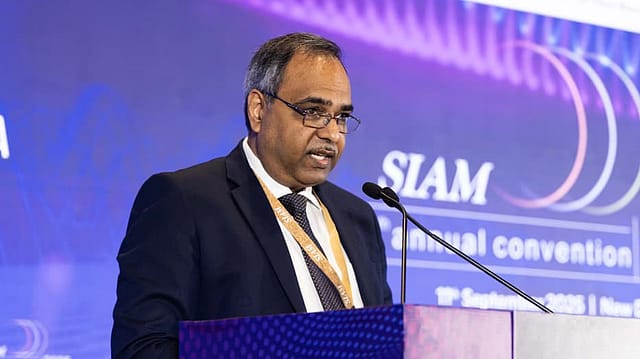
The ongoing conflict in West Asia is emerging as a key risk factor for India’s automobile industry, with potential implications for costs, supply chains and demand visibility, Society of Indian Automobile Manufacturers (SIAM) President Shailesh Chandra stated on Tuesday while announcing FY26 automobile sales at a press briefing.
“Uncertainties arising from the West Asia conflict need to be closely monitored, as it may have impacts on production, commodity prices, fuel prices, freight rates and the overall economy,” said Chandra , adding that prolonged disruption could indirectly weigh on vehicle demand.
His remarks come even as the domestic auto industry closed FY2025-26 on a strong footing, with Passenger Vehicle (PV) sales rising 7.9% year-on-year to a record 4.64 million units, marking the highest-ever annual performance for the segment.
However, Chandra, who is also the Managing Director of Tata Motors' PV arm, cautioned that the external environment is beginning to introduce fresh uncertainty. He described the current situation as “precarious,” particularly due to dependencies on LPG and global supply chains. “So far, industry has been able to manage the supplies, but you have to watch how things pan out,” he said, noting that visibility on production remains limited to the near term.
Freight and input costs begin to tighten
Logistics and input cost pressures are already emerging as a consequence of the geopolitical situation. Some companies are increasingly relying on air freight to manage disruptions in shipping routes, leading to higher operating costs.
“There might be potential cost increases that you will start seeing for vehicles… clarity will emerge over the next four to five weeks,” Chandra said, pointing to rising commodity prices, including petroleum-linked inputs and metals such as aluminium.
He added that fuel price movements remain a key variable for demand, particularly in entry-level segments where affordability and running costs are closely watched by consumers.
At the same time, manufacturers are adjusting operations to reduce exposure to supply shocks. “People who are dependent on LPG have shifted to bulk connections… and more efficient ways of consuming these gases,” he noted, highlighting a gradual shift toward piped natural gas (PNG) usage across facilities.
EV demand shows early response
The crisis is also influencing consumer behaviour. Chandra said there was a visible uptick in Electric Vehicle (EV) interest in March, driven by expectations of higher fuel prices and supply uncertainty.
“This has triggered a significant rise in consideration for electric vehicles… people who were not thinking of buying EVs are now curious,” he said, adding that sustained fuel inflation could further accelerate EV adoption trends.
CAFE 3 norms add structural shift
Alongside geopolitical risks, the industry is also preparing for tighter emission norms under the upcoming Corporate Average Fuel Efficiency (CAFE 3) framework, expected to come into force from April 2027. Industry discussions remain ongoing, with divergent views on regulatory flexibility for smaller cars.
“Our strong view is that there should be greater focus on enablers, and one should avoid going through the route of mandates,” Chandra said, underlining the need for a balanced transition that supports both sustainability goals and market growth.
Despite external risks, macroeconomic fundamentals remain supportive, with GDP growth expected in the 6.5–7% range. However, Chandra cautioned that sustained geopolitical stress could alter the trajectory.
“If the West Asia crisis prolongs… it will definitely be a significant challenge for growth,” he said.